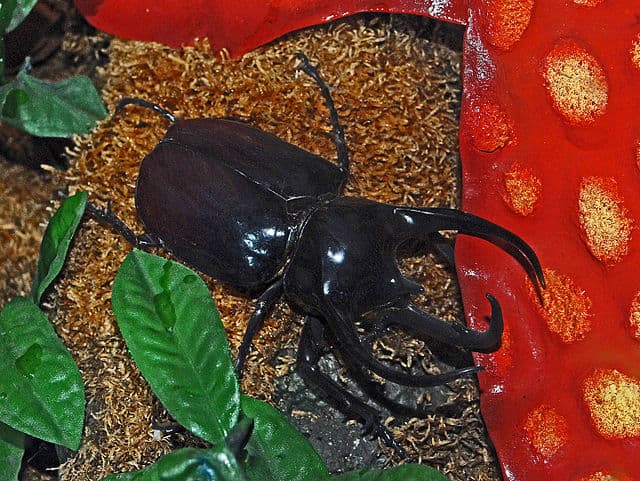
Source: Wikimedia Commons
Caucasus Beetle
IntermediateChalcosoma chiron
Largest beetle in Southeast Asia. Three long horns and aggressive nature. More accessible than Hercules and popular.
Dificultad
Intermediate
Temperatura
20〜28℃
Esperanza de vida
Adult 3-6 months, larva 1 year
Tamaño
Up to 130mm
Humedad
60〜80%
Dieta
Beetle jelly (adult), fermented substrate (larva)
Acerca de
Chalcosoma chiron, commonly called the Caucasus beetle or Atlas beetle, is the largest rhinoceros beetle in Asia, distributed across tropical rainforests of Malaysia, Indonesia, and Thailand. Males bear three prominent horns—one cephalic and two thoracic—and reach total lengths of 50–130 mm. The body displays a lustrous dark green to black coloration. This species is notably aggressive; males use their three horns with great skill in combat over mating rights. Captive temperatures must be kept between 18–25°C, as high heat above 28°C is detrimental. A medium to large enclosure with a fine-mesh lid and at least 15 cm of fermented substrate is recommended. Due to their aggressive temperament, mating should be supervised and kept brief. Adults eat beetle jelly and live approximately 3–8 months. Revered alongside the Hercules beetle as one of the world's strongest beetles, it is a trophy species for serious collectors.
Source: Wikipedia (CC BY-SA 4.0)
Información básica
Origen
Southeast Asia, including Malaysia, Indonesia, and Thailand
Esperanza de vida
Adult 3-6 months, larva 1 year
Tamaño
Up to 130mm
Temperatura
20〜28℃
Humedad
60〜80%
Dieta
Beetle jelly (adult), fermented substrate (larva)
Guía de cuidado
Temperature
18-25°C (very heat-sensitive)
Temperament
Very aggressive — handle with care
Larvae
Fermented substrate. High temperature forbidden
Adult lifespan
Shorter than other beetle species
Notes
Horn grip very strong — pinching is painful
Three hornsLargest in SE AsiaAggressiveCool keeping
Preguntas frecuentes de Caucasus Beetle
Q¿Qué tan difícil es mantener Caucasus Beetle?
A
Intermediate. Esta es una especie de nivel intermedio. Se recomienda algo de experiencia previa y conocimiento de gestión ambiental.
Q¿Cuál es la temperatura ideal para Caucasus Beetle?
A
La temperatura ideal para Caucasus Beetle es 20〜28℃. La humedad recomendada es 60〜80%. Evita cambios bruscos de temperatura y mantén un ambiente estable.
Q¿Cuál es la esperanza de vida de Caucasus Beetle?
A
La esperanza de vida promedio de Caucasus Beetle es Adult 3-6 months, larva 1 year. Con cuidados y nutrición adecuados, pueden vivir una vida larga y saludable.
Q¿Qué tamaño alcanza Caucasus Beetle?
A
Caucasus Beetle típicamente alcanza Up to 130mm como adulto. El tamaño puede variar según las condiciones de cuidado y la genética individual.
Q¿Qué debo alimentar a Caucasus Beetle?
A
Caucasus Beetle se alimenta de: Beetle jelly (adult), fermented substrate (larva). Apunta a una dieta equilibrada con una frecuencia de alimentación adecuada.
Q¿Cuál es el precio típico de Caucasus Beetle?
A
El precio de Caucasus Beetle varía significativamente según el morfo, tamaño y linaje. Consulta nuestra página de precios de mercado para información actualizada.
Especies relacionadas
Buscar listados de esta especie
Explorar listados de InsectArtículos relacionados
Stag Beetle Breeding Temperature Control — Species-Specific Optimal Ranges
Stag beetle temperature control: species-specific ranges for Dorcus, Prosopocoilus, and Lamprima — cooling methods and seasonal cycling.
Rhinoceros Beetle Larvae Care — Mat Management & Temperature for Large Specimens
Rhinoceros beetle larvae care: fermented mat selection, container sizing, replacement timing, temperature management, and pupation chamber preparation.
Hercules Beetle Care Guide — Raising the World's Largest Beetle
Guide to keeping Dynastes hercules: adult and larva care, enclosure size, temperature, diet, substrate changes, and breeding tips.
Growing Bigger Rhinoceros Beetles — Bloodline, Substrate & Temperature Techniques
Techniques for raising larger rhinoceros beetles: selecting quality bloodlines, high-nutrition substrates, and temperature-controlled growth strategies.