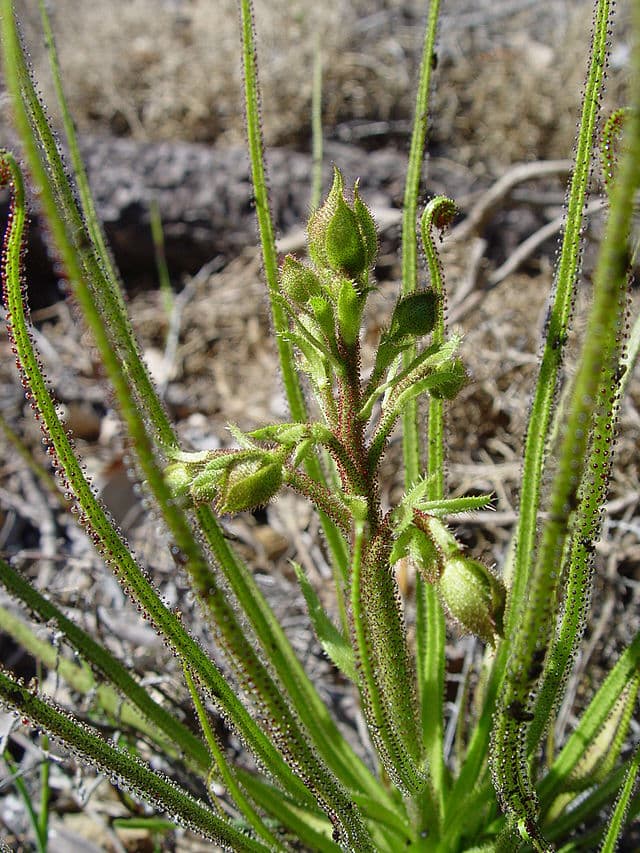
Source: Wikimedia Commons
Drosophyllum Lusitanicum
AdvancedDrosophyllum lusitanicum
A rare carnivorous plant from dry areas, attracting insects with honey-like sweet scent. Dislikes transplanting.
Difficulty
Advanced
Temperature
10〜30℃
Lifespan
3-5 years
Size
20-40cm
Humidity
60〜90%
Diet
Insects (auto-capture)
About
Drosophyllum lusitanicum, the dewy pine or Portuguese sundew, is a remarkable carnivorous plant that defies the typical carnivore association with wetlands: it grows naturally in dry, calcareous scrub and rocky garrigue of southern Portugal, southwestern Spain, and northern Morocco, in well-drained, alkaline soils with a Mediterranean climate. It attracts insects with a powerful honey-like fragrance and traps them on the glandular, mucilaginous tentacles covering its long, pine-needle-like leaves—the 'dewy' shimmer of these giving rise to its common name. Cultivation is contrary to most carnivorous plants: it requires sharply drained, alkaline mineral media (coarse sand, perlite, limestone chips), watering only when the substrate approaches dryness, no tray watering, excellent air circulation, and full direct sun. It is extremely sensitive to root disturbance and should ideally be grown from seed sown directly in its final container.
Basic Info
Origin
Southern Portugal, southwestern Spain, and northern Morocco, dry calcareous scrubland and rocky garrigue
Lifespan
3-5 years
Size
20-40cm
Temperature
10〜30℃
Humidity
60〜90%
Diet
Insects (auto-capture)
Care Guide
Fragrance
Honey scent
Dry
Grows in dry areas
Transplant
Dislikes transplanting
Seeds
Grow from seed
CarnivorousDrosophyllumDryHoney Scent
Drosophyllum Lusitanicum FAQ
QHow difficult is it to keep Drosophyllum Lusitanicum?
A
Advanced. This is an advanced-level species. It requires specialized equipment and advanced husbandry skills with precise environmental control.
QWhat is the ideal temperature for Drosophyllum Lusitanicum?
A
The ideal temperature for Drosophyllum Lusitanicum is 10〜30℃. Recommended humidity is 60〜90%. Avoid sudden temperature changes and maintain a stable environment.
QWhat is the lifespan of Drosophyllum Lusitanicum?
A
The average lifespan of Drosophyllum Lusitanicum is 3-5 years. With proper care and nutrition, they can live a long and healthy life.
QHow large does Drosophyllum Lusitanicum get?
A
Drosophyllum Lusitanicum typically reaches 20-40cm as an adult. Size may vary depending on care conditions and individual genetics.
QWhat should I feed Drosophyllum Lusitanicum?
A
Drosophyllum Lusitanicum feeds on: Insects (auto-capture). Aim for a balanced diet with appropriate feeding frequency.
QWhat is the typical price for Drosophyllum Lusitanicum?
A
The price of Drosophyllum Lusitanicum varies significantly depending on morph, size, and lineage. Check our market price page for the latest pricing information.
Related Species
Find listings for this species
Browse Carnivorous Plant ListingsRelated Articles
Complete Beginner's Guide to Carnivorous Plants
Everything beginners need to start growing carnivorous plants: soil, watering, light, tray culture, overwintering, and recommended starter species.
Carnivorous Plant Encyclopedia — Popular Species & Care Guide
An encyclopedia of popular carnivorous plants with trapping methods, care difficulty, and environment needs for each.
How Much Does Carnivorous Plant Growing Cost? Monthly Running Costs Explained
Monthly carnivorous plant care costs: soil, distilled water, and lighting, with Nepenthes vs. Venus flytrap cost comparisons.
Carnivorous Plant Growth Rate & Size — Species-by-Species Guide
Carnivorous plant growth rates and sizes for Venus flytraps, Nepenthes, and Sarracenia, with tips for growing larger traps.