Hercules Beetle Nominate
AdvancedThe nominate subspecies of king of beetles Hercules. From Guadeloupe, grows largest.
Schwierigkeit
Advanced
Temperatur
20〜28℃
Lebensdauer
Adult 6-12 months
Größe
100-180mm
Luftfeuchtigkeit
60〜80%
Ernährung
Insect jelly
Über uns
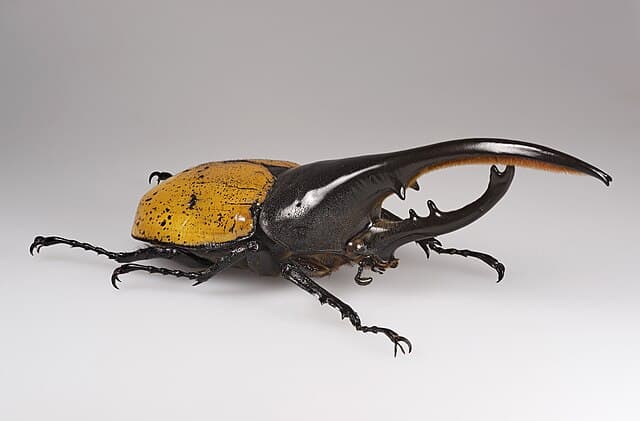
Dynastes hercules hercules, the nominate subspecies of the Hercules beetle, is native to the Lesser Antilles islands of Guadeloupe, Dominica, and adjacent islands in the Caribbean. Among all 17 recognized Hercules beetle subspecies, the nominate is the largest, with males reaching a maximum total length of 180 mm—making it the longest beetle species on Earth. The thoracic horn is notably long and straight, and elytra color shifts from yellowish-green to black with humidity. Captive temperature must be maintained at 20–25°C; temperatures above 28°C are harmful. An extra-large enclosure with fermented substrate at least 20 cm deep is required. Females lay 30–50 eggs per clutch; larvae take 12–24 months to develop. Adults eat beetle jelly or banana and live 6–12 months. Due to its restricted island range, limited availability, and status as the largest and most prestigious Hercules subspecies, D. h. hercules commands the highest prices in the hobby and represents the ultimate achievement for Hercules beetle breeders.
Grundinformationen
Herkunft
Lesser Antilles islands of the Caribbean, including Guadeloupe and Dominica
Lebensdauer
Adult 6-12 months
Größe
100-180mm
Temperatur
20〜28℃
Luftfeuchtigkeit
60〜80%
Ernährung
Insect jelly
Pflegeanleitung
Temperature
Maintain 20-25°C
Housing
Extra-large case with deep insect mat
Larval period
18-24 months
Notes
Largest subspecies. 150mm+ specimens are the goal
HerculesNominateLargestGuadeloupe
Hercules Beetle Nominate-FAQ
QWie schwierig ist es, Hercules Beetle Nominate zu halten?
A
Advanced. Dies ist eine Art für Fortgeschrittene. Sie erfordert spezialisierte Ausrüstung und fortgeschrittene Haltungskenntnisse mit präziser Umgebungskontrolle.
QWas ist die ideale Temperatur für Hercules Beetle Nominate?
A
Die ideale Temperatur für Hercules Beetle Nominate ist 20〜28℃. Die empfohlene Luftfeuchtigkeit beträgt 60〜80%. Vermeiden Sie plötzliche Temperaturänderungen und halten Sie eine stabile Umgebung aufrecht.
QWie ist die Lebenserwartung von Hercules Beetle Nominate?
A
Die durchschnittliche Lebensdauer von Hercules Beetle Nominate beträgt Adult 6-12 months. Bei richtiger Pflege und Ernährung können sie ein langes und gesundes Leben führen.
QWie groß wird Hercules Beetle Nominate?
A
Hercules Beetle Nominate erreicht als Erwachsener typischerweise 100-180mm. Die Größe kann je nach Haltungsbedingungen und individueller Genetik variieren.
QWas sollte ich Hercules Beetle Nominate füttern?
A
Hercules Beetle Nominate ernährt sich von: Insect jelly. Streben Sie eine ausgewogene Ernährung mit angemessener Fütterungshäufigkeit an.
QWas ist der typische Preis für Hercules Beetle Nominate?
A
Der Preis von Hercules Beetle Nominate variiert erheblich je nach Morph, Größe und Abstammung. Überprüfen Sie unsere Marktpreisseite für aktuelle Preisinformationen.
Verwandte Arten
Angebote für diese Art finden
Insect-Angebote durchsuchenVerwandte Artikel
Hercules Beetle Care & Breeding — From Larvae to Eclosion
Hercules beetle care and breeding from larval stage to adult eclosion: substrate, temperature management, and pupal cell care.
Hercules Beetle Care Guide — Raising the World's Largest Beetle
Guide to keeping Dynastes hercules: adult and larva care, enclosure size, temperature, diet, substrate changes, and breeding tips.
Hercules Beetle Rearing Guide — Complete Care from Larva to Adult
Complete guide to raising Hercules beetles from larva to adult: temperature control, substrate selection, stage-by-stage larval management, and adult feeding and care.
How Much Does Insect Keeping Cost? Monthly Running Costs Explained
Monthly insect keeping costs for beetles and stag beetles: substrate, jelly, temperature control, and annual breeding cost estimates.