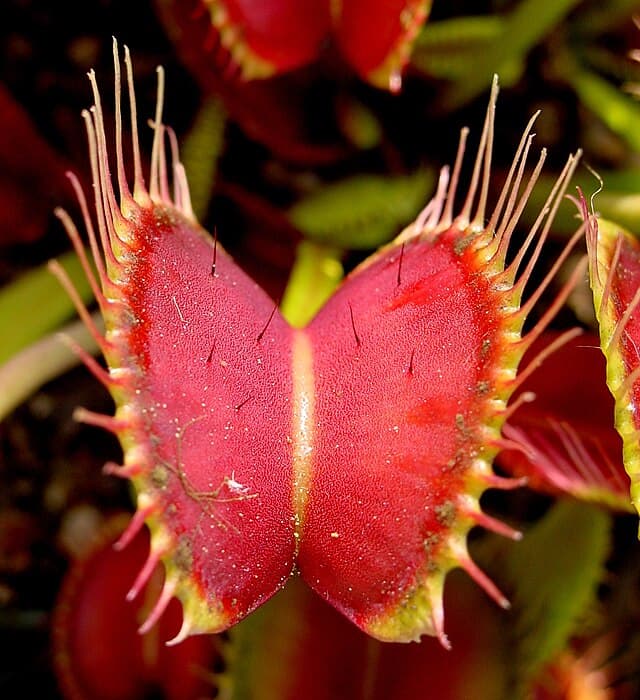
Source: Wikimedia Commons
Venus Flytrap
IntermediateDionaea muscipula
The world's most famous carnivorous plant. Clam-like leaves snap shut in 0.1 seconds to capture insects. Native only to Eastern US wetlands. Requires winter dormancy.
Schwierigkeit
Intermediate
Temperatur
5〜35℃(冬は5℃前後で休眠)
Lebensdauer
10-20 years
Größe
5-15cm
Luftfeuchtigkeit
60〜80%
Ernährung
Photosynthesis + insect prey. Manual feeding unnecessary
Über uns
The Venus flytrap (Dionaea muscipula) is a carnivorous plant native to the subtropical wetlands of North and South Carolina, USA, and is the sole species of the monotypic genus Dionaea. It belongs to the family Droseraceae, closely related to sundews and the waterwheel plant. The plant captures prey—chiefly insects and arachnids—using a hinged, jaw-like trap formed from the terminal portion of each leaf. When an insect contacts one of the trigger hairs inside the trap twice within approximately 20 seconds, the trap snaps shut in as little as one-tenth of a second. Digestive enzymes then dissolve the prey's soft tissue and the plant absorbs the resulting nutrients. Cultivation requires nutrient-poor, acidic media such as pure sphagnum moss or a peat-perlite mix, and fertilizer must never be used. Watering should be done by the tray method using only pure, distilled, or rainwater. Full sun is preferred, and a winter dormancy period at 5–10°C is essential for long-term health.
Source: Wikipedia (CC BY-SA 4.0)
Grundinformationen
Herkunft
the temperate and subtropical wetlands of North Carolina and South Carolina, USA
Lebensdauer
10-20 years
Größe
5-15cm
Temperatur
5〜35℃(冬は5℃前後で休眠)
Luftfeuchtigkeit
60〜80%
Ernährung
Photosynthesis + insect prey. Manual feeding unnecessary
Pflegeanleitung
Soil
Pure sphagnum or peat + perlite. Never use fertilizer
Watering
Bottom watering to keep constantly moist. Use distilled or rain water only
Dormancy
Needs 3-4 month cold dormancy in winter at around 5°C
Notes
Each trap closes only a few times in its life. Don't trigger traps for fun
IntermediateSnap trapDormancy requiredNorth American
Venus Flytrap-FAQ
QWie schwierig ist es, Venus Flytrap zu halten?
A
Intermediate. Dies ist eine Art mittleren Schwierigkeitsgrades. Etwas Vorerfahrung und Kenntnisse im Umgebungsmanagement werden empfohlen.
QWas ist die ideale Temperatur für Venus Flytrap?
A
Die ideale Temperatur für Venus Flytrap ist 5〜35℃(冬は5℃前後で休眠). Die empfohlene Luftfeuchtigkeit beträgt 60〜80%. Vermeiden Sie plötzliche Temperaturänderungen und halten Sie eine stabile Umgebung aufrecht.
QWie ist die Lebenserwartung von Venus Flytrap?
A
Die durchschnittliche Lebensdauer von Venus Flytrap beträgt 10-20 years. Bei richtiger Pflege und Ernährung können sie ein langes und gesundes Leben führen.
QWie groß wird Venus Flytrap?
A
Venus Flytrap erreicht als Erwachsener typischerweise 5-15cm. Die Größe kann je nach Haltungsbedingungen und individueller Genetik variieren.
QWas sollte ich Venus Flytrap füttern?
A
Venus Flytrap ernährt sich von: Photosynthesis + insect prey. Manual feeding unnecessary. Streben Sie eine ausgewogene Ernährung mit angemessener Fütterungshäufigkeit an.
QWas ist der typische Preis für Venus Flytrap?
A
Der Preis von Venus Flytrap variiert erheblich je nach Morph, Größe und Abstammung. Überprüfen Sie unsere Marktpreisseite für aktuelle Preisinformationen.
Verwandte Arten
Angebote für diese Art finden
Carnivorous Plant-Angebote durchsuchenVerwandte Artikel
Venus Flytrap Variety Guide: Red, Giant & Unusual Cultivars
Venus flytrap variety guide: Red Dragon, B52 giant, Fang mutant, and more — characteristics and care differences for each cultivar.
Nepenthes vs. Venus Flytrap — Which Carnivorous Plant Is Easier to Grow?
Nepenthes vs. Venus flytrap comparison: growing conditions, temperature, watering, dormancy, and beginner-friendly varieties.
Venus Flytrap vs Nepenthes: Care, Cost & Feature Comparison
Venus Flytrap vs Nepenthes: trapping method, growing conditions, winter care, and price comparison.
Complete Beginner's Guide to Carnivorous Plants
Everything beginners need to start growing carnivorous plants: soil, watering, light, tray culture, overwintering, and recommended starter species.