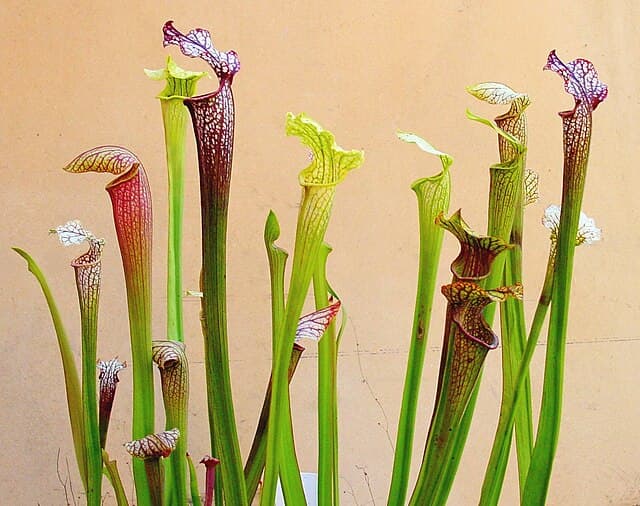
Source: Wikimedia Commons
Sarracenia
BeginnerSarracenia spp.
North American tube-shaped pitcher plant with beautifully patterned and colored upright traps. Cold-hardy enough for outdoor cultivation in Japan. Many hybrids exist for collectors.
Schwierigkeit
Beginner
Temperatur
-10〜35℃
Lebensdauer
20+ years
Größe
15-100cm (varies by species)
Luftfeuchtigkeit
50〜80%
Ernährung
Photosynthesis + insects captured in tubular pitchers
Über uns
Sarracenia, commonly called North American pitcher plants or trumpet pitchers, is a genus of 8 to 11 species native to the wetlands of eastern North America, from the Gulf Coast to the subarctic bogs of Canada. The plants form upright, tubular pitchers with nectar-secreting rims that attract insects; downward-pointing hairs inside the tube prevent escape, and a pool of digestive fluid at the base dissolves and absorbs prey. Striking patterns of red veining and translucent windows on the pitcher and lid make many species highly ornamental, and their spring flowers are also attractive. Cultivation requires acidic, nutrient-poor media such as sphagnum or a peat-perlite mix, with tray watering using only pure or rainwater. Full sun is essential for good coloration, and a cold winter dormancy is critical for the plants' long-term health.
Source: Wikipedia (CC BY-SA 4.0)
Grundinformationen
Herkunft
Eastern North America, from the Gulf Coast to subarctic bogs of Canada
Lebensdauer
20+ years
Größe
15-100cm (varies by species)
Temperatur
-10〜35℃
Luftfeuchtigkeit
50〜80%
Ernährung
Photosynthesis + insects captured in tubular pitchers
Pflegeanleitung
Soil
Sphagnum or peat + perlite. No fertilizer
Watering
Tray watering to keep moist. Use distilled or rain water
Light
Full sun essential. Insufficient light causes pale, weak traps
Notes
Above-ground parts die back in winter but rhizome survives. Regrows in spring
Beginner-friendlyCold-hardyOutdoor OKTubular trap
Sarracenia-FAQ
QWie schwierig ist es, Sarracenia zu halten?
A
Beginner. Dies ist eine anfängerfreundliche Art. Es sind keine spezielle Ausrüstung oder Erfahrung erforderlich, und sie kann mit einer einfachen Pflegeeinrichtung erfolgreich gehalten werden.
QWas ist die ideale Temperatur für Sarracenia?
A
Die ideale Temperatur für Sarracenia ist -10〜35℃. Die empfohlene Luftfeuchtigkeit beträgt 50〜80%. Vermeiden Sie plötzliche Temperaturänderungen und halten Sie eine stabile Umgebung aufrecht.
QWie ist die Lebenserwartung von Sarracenia?
A
Die durchschnittliche Lebensdauer von Sarracenia beträgt 20+ years. Bei richtiger Pflege und Ernährung können sie ein langes und gesundes Leben führen.
QWie groß wird Sarracenia?
A
Sarracenia erreicht als Erwachsener typischerweise 15-100cm (varies by species). Die Größe kann je nach Haltungsbedingungen und individueller Genetik variieren.
QWas sollte ich Sarracenia füttern?
A
Sarracenia ernährt sich von: Photosynthesis + insects captured in tubular pitchers. Streben Sie eine ausgewogene Ernährung mit angemessener Fütterungshäufigkeit an.
QWas ist der typische Preis für Sarracenia?
A
Der Preis von Sarracenia variiert erheblich je nach Morph, Größe und Abstammung. Überprüfen Sie unsere Marktpreisseite für aktuelle Preisinformationen.
Sarracenia Q&A
Verwandte Arten
Angebote für diese Art finden
Carnivorous Plant-Angebote durchsuchenVerwandte Artikel
Sarracenia Outdoor Growing Guide: Cold-Hardy Carnivorous Plants
Sarracenia outdoor growing: placement, tray water depth and quality, winter dormancy, flower enjoyment, and hybrid cultivar selection.
Complete Sarracenia Growing Guide — Varieties, Outdoor Culture & Winter Care
Sarracenia guide: popular varieties, outdoor growing advantages, soil mix, watering, and winter dormancy management.
Sarracenia Outdoor Growing Guide — Cold Hardiness & Annual Care
Growing Sarracenia outdoors: cold hardiness, annual care schedule, soil mix, watering, and light management.
Sarracenia Outdoor Growing Guide — Thriving in Japanese Climate
Growing Sarracenia outdoors in Japan: species selection, soil and pots, seasonal care calendar, and pest management.