Praying mantis care and breeding: species selection, enclosure setup, live feeding, mating precautions, ootheca management, and nymph rearing.
要点总结
Praying mantis care and breeding: species selection, enclosure setup, live feeding, mating precautions, ootheca management, and nymph rearing.
Praying mantises stand apart in the world of invertebrate keeping. Their forward-facing eyes, swiveling heads, and lightning-fast strike reflexes convey an intelligence rarely seen in insects. Whether you're drawn to the alien elegance of a Ghost Mantis or the jaw-dropping mimicry of an Orchid Mantis, these predators reward patient keepers with behavior that is endlessly engaging to observe.
The diversity within Mantodea means there is a mantis for nearly every experience level. The Giant Asian Mantis (*Hierodula membranacea*) is the classic beginner choice — robust, tolerant of minor care mistakes, and large enough to feed easily on common feeder insects. The Chinese Mantis (*Tenodera sinensis*) shares similar hardiness and can grow impressively large.
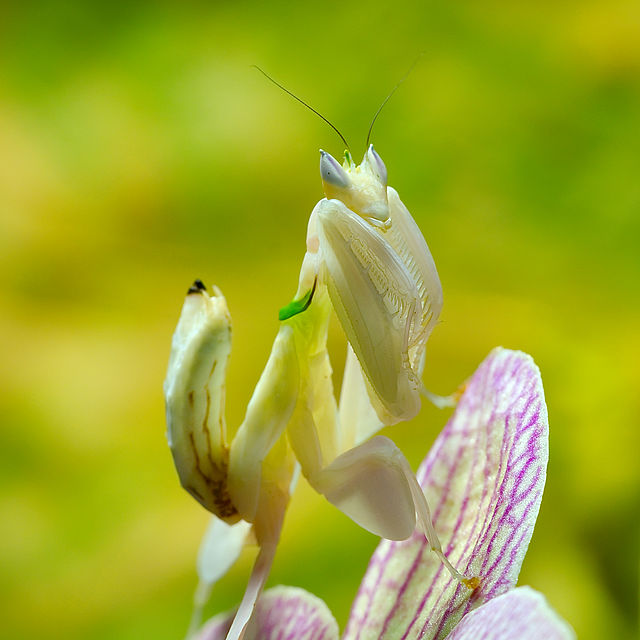
Intermediate keepers gravitate toward the Orchid Mantis (*Hymenopus coronatus*), whose pink-and-white petal-like lobes make it one of the most visually stunning invertebrates in the hobby. It requires higher humidity and warmer temperatures than hardier species. The Dead Leaf Mantis (*Deroplatys desiccata*) is another intermediate species, prized for its extraordinary camouflage — when motionless among fallen leaves it is virtually invisible.
The Ghost Mantis (*Phyllocrania paradoxa*) is an excellent species for those wanting something unusual at a manageable size; its jagged, leaf-like pronotum and dark coloration make it look like a piece of dried vegetation. For Japanese keepers, the native Japanese Mantis (*Tenodera angustipennis*) is widely available, legally collected, and straightforward to maintain.
Mantises are arboreal hunters that orient themselves vertically, so enclosure height is the critical dimension. A minimum height of three times the mantis's body length is essential — this ensures safe molting, since mantises hang upside down and must have adequate space to shed their exoskeleton without deformity. A mantis stuck mid-molt due to insufficient height will often be permanently injured.
Cross-ventilated plastic keeper containers with mesh lids work well for most species. Avoid glass tanks, which retain too much moisture and restrict airflow. Provide branches, cork bark tubes, or artificial plants for perching and hiding. The substrate is largely cosmetic — paper towel is hygienic and easy to clean, while a thin layer of coconut fiber retains humidity for tropical species.
Temperature and humidity requirements vary significantly by species. Orchid Mantises prefer 28–32°C with 60–80% humidity, while Ghost Mantises do well at 22–26°C with moderate humidity around 50–60%. Research your species before setting up the enclosure.
Mantises are obligate live-prey feeders and will rarely accept dead insects. Offer prey items no larger than the mantis's head — oversized prey can injure a mantis, while prey that is too small will be ignored or missed. Crickets and locust hoppers are the staple for medium to large species. Fruit flies (*Drosophila* spp.) are indispensable for newly hatched nymphs and small adult species. Mealworms and wax moth larvae make excellent occasional treats.
Feed adult mantises every 2–3 days. Juveniles can be fed daily. Remove any uneaten prey after 24 hours to prevent stress to the mantis. Avoid feeding within 48 hours of a molt, as mantises typically refuse food in the pre-molt phase anyway.
Hydration is managed through light misting. Lightly spray one side of the enclosure each morning or evening — mantises drink water droplets directly from surfaces. Avoid soaking the enclosure, as stagnant moisture promotes mold and bacterial growth.
Mantises molt multiple times before reaching adulthood, and each molt is a critical and vulnerable event. In the days preceding a molt, the mantis will become inactive, refuse food, and often hang motionless from the enclosure lid or a branch. Do not disturb a molting mantis under any circumstances.
After molting, the mantis is soft and pale — it needs 24–48 hours to harden before feeding again. Offering live prey too soon can result in injury. Failed molts are one of the most common causes of death in captive mantises and are almost always linked to insufficient enclosure height, excessive substrate moisture, or forced disturbance during the process.
Breeding mantises requires careful preparation. Females are significantly larger than males and will readily cannibalize a male if she is hungry or feels threatened. Feed the female generously for at least a week before introducing the male. Attempt introductions in a large enclosure with plenty of perching surfaces, and never leave a mating pair unattended for extended periods. Remove the male immediately after mating is confirmed.
After successful mating, a well-fed female will produce one or more oothecae — foamy egg cases that harden into a protective shell. The number of eggs depends on the species, ranging from a few dozen to several hundred. Keep oothecae at appropriate temperature and moderate humidity. Most temperate species require a cooler winter period (diapause) before hatching; tropical species typically hatch within 4–8 weeks.
Hatchlings emerge as tiny, active L1 nymphs and must be fed immediately. Fruit flies are typically the only prey item small enough for first-instar nymphs. Separate nymphs as early as possible — even very young mantises will cannibalize siblings. Individual small containers with ventilation work well.
As nymphs develop through successive instars, gradually increase prey size. Maintain consistent temperatures and mist lightly every day. With attentive care, most species reach adulthood in 4–8 months. Document each molt to track instar stage and anticipate the final adult molt, after which females can be bred.
Bri-Choku connects enthusiasts directly with experienced breeders offering healthy, captive-bred mantis species — from beginner-friendly Giant Asian Mantis to rare and exotic varieties. Breeders on the platform provide species-specific care guidance, so you can start your mantis journey with confidence.
Breeding Calendar
Visual monthly breeding season guide for each species
Care Cost Calculator
Estimate initial setup costs and monthly running costs by category
Environment Checker
Get pet & plant recommendations based on room temperature, space & time
Seasonal Care Calendar
Monthly care events and seasonal management tips at a glance