Source: Wikimedia Commons
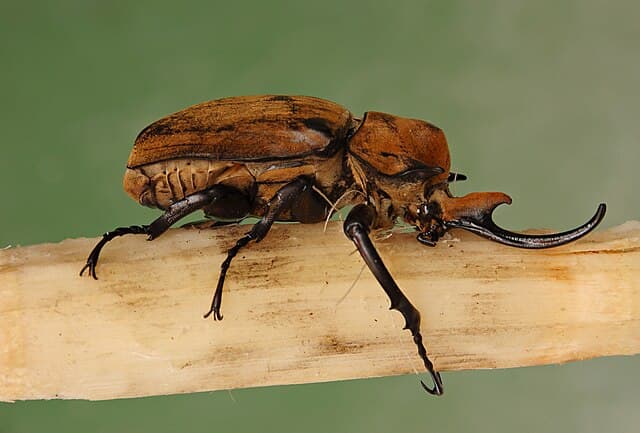
Elephant Beetle
IntermediateElephant beetle
The world's heaviest class of beetle. Stocky body and small horn reminiscent of an elephant.
Schwierigkeit
Intermediate
Temperatur
20〜28℃
Lebensdauer
Adult 3-6 months
Größe
50-130mm
Luftfeuchtigkeit
60〜80%
Ernährung
Insect jelly, Banana
Über uns
Megasoma elephas, the elephant beetle, is a large Neotropical rhinoceros beetle in the family Scarabaeidae, subfamily Dynastinae, distributed across tropical rainforests from Mexico to Venezuela. It is renowned as the heaviest beetle in the world by larval mass, with larvae sometimes exceeding 100 g. Males bear both cephalic and thoracic horns and reach 50–130 mm in body length; the entire body is densely covered with fine hairs, a characteristic feature of the genus Megasoma. Optimal captive temperature is 22–27°C. Because larvae grow exceptionally large, housing must be spacious, and substantial quantities of leaf litter or fermented substrate are required throughout the lengthy larval period of 18–36 months. Egg-laying occurs in fermented substrate. Adults are fed beetle jelly or banana and live approximately 3–6 months. The elephant beetle's massive proportions and the scale of husbandry required make it a rewarding challenge for experienced beetle keepers.
Source: Wikipedia (CC BY-SA 4.0)
Grundinformationen
Herkunft
tropical rainforests from Mexico to Venezuela in Central and northern South America
Lebensdauer
Adult 3-6 months
Größe
50-130mm
Temperatur
20〜28℃
Luftfeuchtigkeit
60〜80%
Ernährung
Insect jelly, Banana
Pflegeanleitung
Housing
幼虫が非常に大きくなるため大型容器必須
Temperature
温度は22〜27℃が適温
Growth
幼虫期間は12〜18ヶ月
Housing
マットは深さ20cm以上必要
Notes
成虫は温厚で扱いやすい
ElephantHeaviest classMegasomaLarge larvae
Elephant Beetle-FAQ
QWie schwierig ist es, Elephant Beetle zu halten?
A
Intermediate. Dies ist eine Art mittleren Schwierigkeitsgrades. Etwas Vorerfahrung und Kenntnisse im Umgebungsmanagement werden empfohlen.
QWas ist die ideale Temperatur für Elephant Beetle?
A
Die ideale Temperatur für Elephant Beetle ist 20〜28℃. Die empfohlene Luftfeuchtigkeit beträgt 60〜80%. Vermeiden Sie plötzliche Temperaturänderungen und halten Sie eine stabile Umgebung aufrecht.
QWie ist die Lebenserwartung von Elephant Beetle?
A
Die durchschnittliche Lebensdauer von Elephant Beetle beträgt Adult 3-6 months. Bei richtiger Pflege und Ernährung können sie ein langes und gesundes Leben führen.
QWie groß wird Elephant Beetle?
A
Elephant Beetle erreicht als Erwachsener typischerweise 50-130mm. Die Größe kann je nach Haltungsbedingungen und individueller Genetik variieren.
QWas sollte ich Elephant Beetle füttern?
A
Elephant Beetle ernährt sich von: Insect jelly, Banana. Streben Sie eine ausgewogene Ernährung mit angemessener Fütterungshäufigkeit an.
QWas ist der typische Preis für Elephant Beetle?
A
Der Preis von Elephant Beetle variiert erheblich je nach Morph, Größe und Abstammung. Überprüfen Sie unsere Marktpreisseite für aktuelle Preisinformationen.
Verwandte Arten
Angebote für diese Art finden
Insect-Angebote durchsuchenVerwandte Artikel
Stag Beetle Breeding Temperature Control — Species-Specific Optimal Ranges
Stag beetle temperature control: species-specific ranges for Dorcus, Prosopocoilus, and Lamprima — cooling methods and seasonal cycling.
Rhinoceros Beetle Larvae Care — Mat Management & Temperature for Large Specimens
Rhinoceros beetle larvae care: fermented mat selection, container sizing, replacement timing, temperature management, and pupation chamber preparation.
Hercules Beetle Care Guide — Raising the World's Largest Beetle
Guide to keeping Dynastes hercules: adult and larva care, enclosure size, temperature, diet, substrate changes, and breeding tips.
Growing Bigger Rhinoceros Beetles — Bloodline, Substrate & Temperature Techniques
Techniques for raising larger rhinoceros beetles: selecting quality bloodlines, high-nutrition substrates, and temperature-controlled growth strategies.