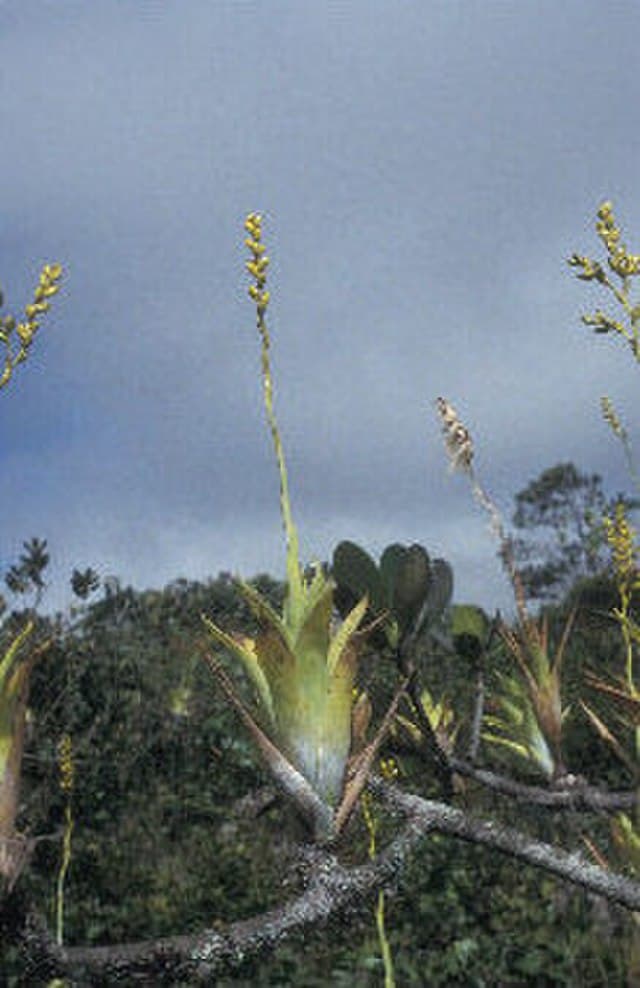
Source: Wikimedia Commons
Catopsis Berteroniana
IntermediateCatopsis berteroniana
A bromeliad carnivorous plant that traps insects with waxy leaf surfaces, drowning them in leaf-cup water for nutrients.
Schwierigkeit
Intermediate
Temperatur
10〜30℃
Lebensdauer
5-10 years
Größe
20-50cm
Luftfeuchtigkeit
60〜90%
Ernährung
Insects (auto-capture)
Über uns
Catopsis berteroniana is a bromeliad (family Bromeliaceae) native to southern Florida, Central America, the Caribbean, and tropical South America, where it grows as an epiphyte in humid forests. It is considered the most carnivorous member of the Bromeliaceae, though it is debated as a true carnivore: the inner leaf surfaces are coated with ultraviolet-reflective white farina (waxy powder) that attracts and possibly disorients insects, causing them to fall into the central water-holding tank formed by the overlapping leaf bases. Trapped insects drown and are decomposed by microbial activity in the tank water, with the plant absorbing the released nutrients through specialized leaf trichomes. No digestive enzymes are produced by the plant itself. Cultivation follows bromeliad culture: epiphytic well-draining media, pure or rainwater in the central tank, high humidity, and warm temperatures (20–35°C).
Grundinformationen
Herkunft
Southern Florida, Central America, Caribbean, and tropical South America, humid forest epiphytes
Lebensdauer
5-10 years
Größe
20-50cm
Temperatur
10〜30℃
Luftfeuchtigkeit
60〜90%
Ernährung
Insects (auto-capture)
Pflegeanleitung
Trapping
Waxy slip-trap
Epiphyte
Tree-dwelling
Watering
Keep water in leaf cup
Light
Bright indirect light
CarnivorousCatopsisBromeliadEpiphyte
Catopsis Berteroniana-FAQ
QWie schwierig ist es, Catopsis Berteroniana zu halten?
A
Intermediate. Dies ist eine Art mittleren Schwierigkeitsgrades. Etwas Vorerfahrung und Kenntnisse im Umgebungsmanagement werden empfohlen.
QWas ist die ideale Temperatur für Catopsis Berteroniana?
A
Die ideale Temperatur für Catopsis Berteroniana ist 10〜30℃. Die empfohlene Luftfeuchtigkeit beträgt 60〜90%. Vermeiden Sie plötzliche Temperaturänderungen und halten Sie eine stabile Umgebung aufrecht.
QWie ist die Lebenserwartung von Catopsis Berteroniana?
A
Die durchschnittliche Lebensdauer von Catopsis Berteroniana beträgt 5-10 years. Bei richtiger Pflege und Ernährung können sie ein langes und gesundes Leben führen.
QWie groß wird Catopsis Berteroniana?
A
Catopsis Berteroniana erreicht als Erwachsener typischerweise 20-50cm. Die Größe kann je nach Haltungsbedingungen und individueller Genetik variieren.
QWas sollte ich Catopsis Berteroniana füttern?
A
Catopsis Berteroniana ernährt sich von: Insects (auto-capture). Streben Sie eine ausgewogene Ernährung mit angemessener Fütterungshäufigkeit an.
QWas ist der typische Preis für Catopsis Berteroniana?
A
Der Preis von Catopsis Berteroniana variiert erheblich je nach Morph, Größe und Abstammung. Überprüfen Sie unsere Marktpreisseite für aktuelle Preisinformationen.
Verwandte Arten
Angebote für diese Art finden
Carnivorous Plant-Angebote durchsuchenVerwandte Artikel
Complete Beginner's Guide to Carnivorous Plants
Everything beginners need to start growing carnivorous plants: soil, watering, light, tray culture, overwintering, and recommended starter species.
Carnivorous Plant Encyclopedia — Popular Species & Care Guide
An encyclopedia of popular carnivorous plants with trapping methods, care difficulty, and environment needs for each.
How Much Does Carnivorous Plant Growing Cost? Monthly Running Costs Explained
Monthly carnivorous plant care costs: soil, distilled water, and lighting, with Nepenthes vs. Venus flytrap cost comparisons.
Carnivorous Plant Growth Rate & Size — Species-by-Species Guide
Carnivorous plant growth rates and sizes for Venus flytraps, Nepenthes, and Sarracenia, with tips for growing larger traps.