Source: Wikimedia Commons
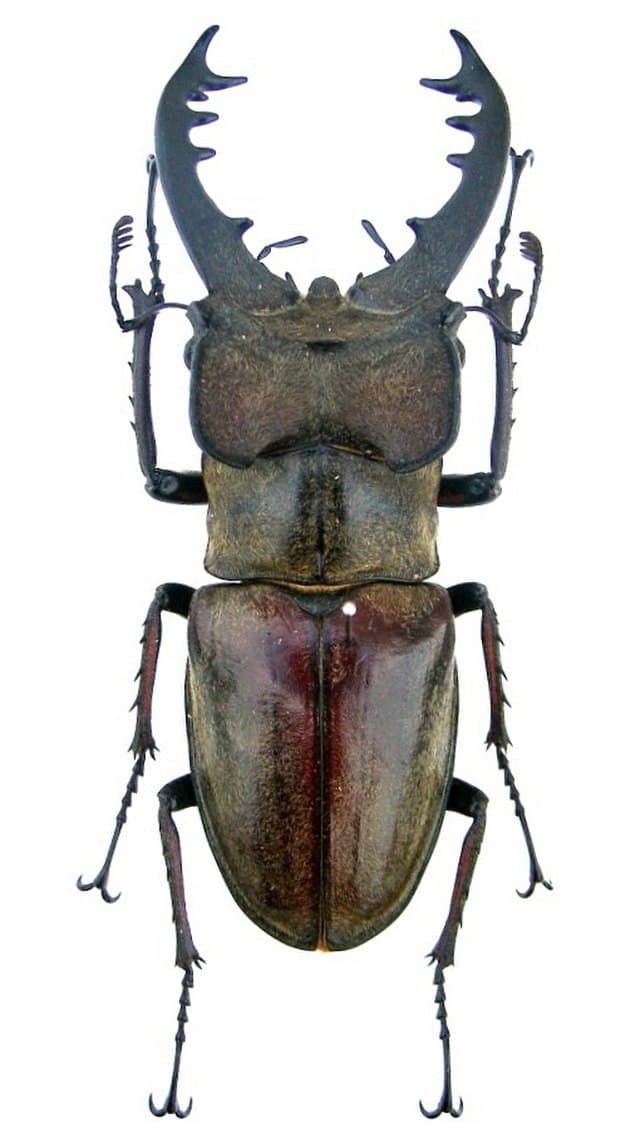
Miyama Stag Beetle
AdvancedBeautiful stag beetle from Japanese mountains. Crown-like head protrusion is distinctive. Requires cool temperatures for keeping.
Dificuldade
Advanced
Temperatura
20〜28℃
Expectativa de vida
Adult 2-3 months
Tamanho
Up to 75mm
Umidade
60〜80%
Dieta
Beetle jelly
Sobre
Lucanus maculifemoratus, the miyama stag beetle, inhabits mountainous forests of Japan at elevations above approximately 400 meters, with a range extending from Hokkaido to Kyushu. It is distinguished by prominent ear-like projections on the head and highly variable mandible forms, classified into base-tooth, Fuji-mountain, and water-buffalo types. Adults reach 35–75 mm in length and display brownish to dark brown coloration with distinctive yellow hairs near the leg bases. As an alpine species, it is extremely sensitive to high temperatures; captive husbandry requires strict temperature management at 15–22°C, typically necessitating a dedicated insect cooling unit. Adult lifespan is 2–3 months, which is brief even by stag beetle standards. Egg-laying occurs in hardwood logs or fermented substrate. Revered as a symbol of the Japanese summer mountains, the miyama stag beetle's unique head projections and imposing size make it a beloved and sought-after native species.
Informações básicas
Origem
mountainous regions of Japan, from Hokkaido to Kyushu
Expectativa de vida
Adult 2-3 months
Tamanho
Up to 75mm
Temperatura
20〜28℃
Umidade
60〜80%
Dieta
Beetle jelly
Guia de Cuidados
Temperature
15-22°C (high temperature forbidden)
Adult lifespan
Very short adult lifespan
Collecting
Can be collected at lights in summer
Breeding
Captive breeding is difficult
Notes
Weakens rapidly above 25°C — air conditioning essential
Japanese nativeCrown protrusionCool-lovingShort-lived
FAQ de Miyama Stag Beetle
QQual a dificuldade de manter Miyama Stag Beetle?
A
Advanced. Esta é uma espécie de nível avançado. Requer equipamento especializado e habilidades avançadas de criação com controle ambiental preciso.
QQual é a temperatura ideal para Miyama Stag Beetle?
A
A temperatura ideal para Miyama Stag Beetle é 20〜28℃. A umidade recomendada é 60〜80%. Evite mudanças bruscas de temperatura e mantenha um ambiente estável.
QQual é a expectativa de vida de Miyama Stag Beetle?
A
A expectativa de vida média de Miyama Stag Beetle é Adult 2-3 months. Com cuidados e nutrição adequados, podem viver uma vida longa e saudável.
QQual o tamanho que Miyama Stag Beetle atinge?
A
Miyama Stag Beetle normalmente atinge Up to 75mm quando adulto. O tamanho pode variar dependendo das condições de cuidado e genética individual.
QO que devo alimentar Miyama Stag Beetle?
A
Miyama Stag Beetle se alimenta de: Beetle jelly. Busque uma dieta equilibrada com frequência de alimentação adequada.
QQual é o preço típico de Miyama Stag Beetle?
A
O preço de Miyama Stag Beetle varia significativamente dependendo do morfo, tamanho e linhagem. Consulte nossa página de preços de mercado para informações atualizadas.
Espécies relacionadas
Encontrar listagens desta espécie
Explorar listagens de InsectArtigos relacionados
Stag Beetle Breeding Temperature Control — Species-Specific Optimal Ranges
Stag beetle temperature control: species-specific ranges for Dorcus, Prosopocoilus, and Lamprima — cooling methods and seasonal cycling.
Foreign Stag Beetle Overwintering Guide — Tropical vs Temperate Species
Guide to overwintering imported stag beetles: heating for tropical species, dormancy for temperate species, and species-specific temperatures.
Complete Stage Management for Stag Beetles & Rhinoceros Beetles: Larvae, Pupa & Post-Eclosion Care
Stage-by-stage care guide for stag beetles and rhinoceros beetles: larval substrate and temperature management, pupal cell preparation, and post-eclosion adult care with timing and transition tips.
Complete Stag Beetle Species Guide — Characteristics and Difficulty of Japanese and Popular Imported Species
Comprehensive guide to stag beetle species: Japanese natives like Dorcus hopei and Lucanus maculosus, plus popular imports like Giraffa, Palawan, and Caucasus stag beetles.