Source: Wikimedia Commons
Drosophyllum Lusitanicum
AdvancedDrosophyllum lusitanicum
A rare carnivorous plant from dry areas, attracting insects with honey-like sweet scent. Dislikes transplanting.
Dificuldade
Advanced
Temperatura
10〜30℃
Expectativa de vida
3-5 years
Tamanho
20-40cm
Umidade
60〜90%
Dieta
Insects (auto-capture)
Sobre
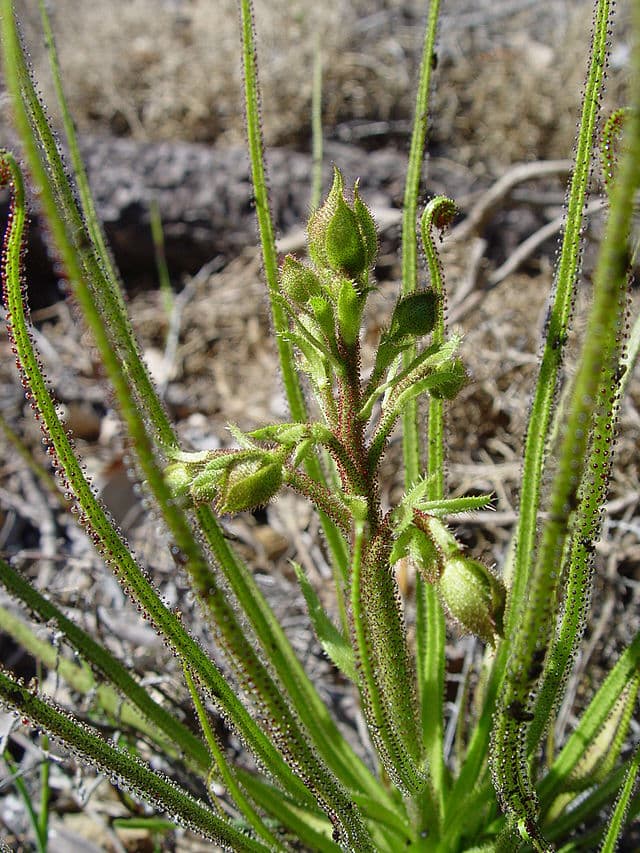
Drosophyllum lusitanicum, the dewy pine or Portuguese sundew, is a remarkable carnivorous plant that defies the typical carnivore association with wetlands: it grows naturally in dry, calcareous scrub and rocky garrigue of southern Portugal, southwestern Spain, and northern Morocco, in well-drained, alkaline soils with a Mediterranean climate. It attracts insects with a powerful honey-like fragrance and traps them on the glandular, mucilaginous tentacles covering its long, pine-needle-like leaves—the 'dewy' shimmer of these giving rise to its common name. Cultivation is contrary to most carnivorous plants: it requires sharply drained, alkaline mineral media (coarse sand, perlite, limestone chips), watering only when the substrate approaches dryness, no tray watering, excellent air circulation, and full direct sun. It is extremely sensitive to root disturbance and should ideally be grown from seed sown directly in its final container.
Informações básicas
Origem
Southern Portugal, southwestern Spain, and northern Morocco, dry calcareous scrubland and rocky garrigue
Expectativa de vida
3-5 years
Tamanho
20-40cm
Temperatura
10〜30℃
Umidade
60〜90%
Dieta
Insects (auto-capture)
Guia de Cuidados
Fragrance
Honey scent
Dry
Grows in dry areas
Transplant
Dislikes transplanting
Seeds
Grow from seed
CarnivorousDrosophyllumDryHoney Scent
FAQ de Drosophyllum Lusitanicum
QQual a dificuldade de manter Drosophyllum Lusitanicum?
A
Advanced. Esta é uma espécie de nível avançado. Requer equipamento especializado e habilidades avançadas de criação com controle ambiental preciso.
QQual é a temperatura ideal para Drosophyllum Lusitanicum?
A
A temperatura ideal para Drosophyllum Lusitanicum é 10〜30℃. A umidade recomendada é 60〜90%. Evite mudanças bruscas de temperatura e mantenha um ambiente estável.
QQual é a expectativa de vida de Drosophyllum Lusitanicum?
A
A expectativa de vida média de Drosophyllum Lusitanicum é 3-5 years. Com cuidados e nutrição adequados, podem viver uma vida longa e saudável.
QQual o tamanho que Drosophyllum Lusitanicum atinge?
A
Drosophyllum Lusitanicum normalmente atinge 20-40cm quando adulto. O tamanho pode variar dependendo das condições de cuidado e genética individual.
QO que devo alimentar Drosophyllum Lusitanicum?
A
Drosophyllum Lusitanicum se alimenta de: Insects (auto-capture). Busque uma dieta equilibrada com frequência de alimentação adequada.
QQual é o preço típico de Drosophyllum Lusitanicum?
A
O preço de Drosophyllum Lusitanicum varia significativamente dependendo do morfo, tamanho e linhagem. Consulte nossa página de preços de mercado para informações atualizadas.
Espécies relacionadas
Encontrar listagens desta espécie
Explorar listagens de Carnivorous PlantArtigos relacionados
Complete Beginner's Guide to Carnivorous Plants
Everything beginners need to start growing carnivorous plants: soil, watering, light, tray culture, overwintering, and recommended starter species.
Carnivorous Plant Encyclopedia — Popular Species & Care Guide
An encyclopedia of popular carnivorous plants with trapping methods, care difficulty, and environment needs for each.
How Much Does Carnivorous Plant Growing Cost? Monthly Running Costs Explained
Monthly carnivorous plant care costs: soil, distilled water, and lighting, with Nepenthes vs. Venus flytrap cost comparisons.
Carnivorous Plant Growth Rate & Size — Species-by-Species Guide
Carnivorous plant growth rates and sizes for Venus flytraps, Nepenthes, and Sarracenia, with tips for growing larger traps.