Source: Wikimedia Commons
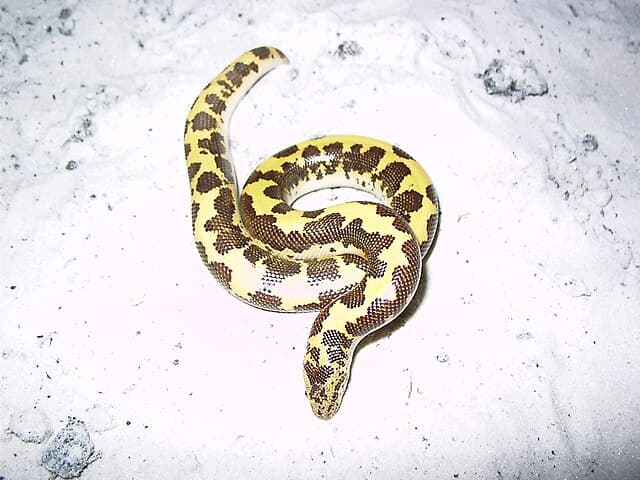
Kenyan Sand Boa
BeginnerA small boa living buried in sand. Gentle and space-efficient beginner snake.
Difficulté
Beginner
Température
25〜32℃
Durée de vie
15-20 years
Taille
40-70cm
Humidité
40〜70%
Régime alimentaire
Mice
À propos
The Kenyan sand boa (Gongylophis colubrinus), also called the Egyptian sand boa, is a small, burrowing boa native to arid and semi-arid regions of East Africa, including Kenya, Tanzania, Egypt, Ethiopia, and Sudan. Adults typically reach 40–70 cm, with females considerably larger than males. The body is stout and cylindrical, and the blunt tail is used to anchor the snake while it bursts from the substrate to seize prey. Coloration is typically orange or yellow with brown saddle blotches. Kenyan sand boas are highly docile, rarely bite, and can be housed in compact enclosures with a deep sand substrate that allows burrowing. A hot spot of around 35°C and a cool side of 25°C are recommended. Their small size, gentle temperament, and ease of care make them one of the most recommended beginner snakes.
Informations de base
Origine
East Africa (Kenya, Egypt, Ethiopia, Sudan and surrounding regions)
Durée de vie
15-20 years
Taille
40-70cm
Température
25〜32℃
Humidité
40〜70%
Régime alimentaire
Mice
Guide d'entretien
Housing
Small cage with sand substrate
Temperature
Hot spot 35°C, cool side 25°C
Feeding
Small mouse every 2 weeks
Notes
Usually hidden buried in sand
Sand BoaSand burrowingSmallSpace-efficient
FAQ Kenyan Sand Boa
QQuelle est la difficulté de garder Kenyan Sand Boa ?
A
Beginner. C'est une espèce adaptée aux débutants. Aucun équipement spécial ni expérience n'est requis, et elle peut être maintenue avec succès avec une installation de soins de base.
QQuelle est la température idéale pour Kenyan Sand Boa ?
A
La température idéale pour Kenyan Sand Boa est 25〜32℃. L'humidité recommandée est 40〜70%. Évitez les changements brusques de température et maintenez un environnement stable.
QQuelle est la durée de vie de Kenyan Sand Boa ?
A
La durée de vie moyenne de Kenyan Sand Boa est 15-20 years. Avec des soins et une alimentation appropriés, ils peuvent vivre longtemps en bonne santé.
QQuelle taille atteint Kenyan Sand Boa ?
A
Kenyan Sand Boa atteint généralement 40-70cm à l'âge adulte. La taille peut varier selon les conditions de soins et la génétique individuelle.
QQue dois-je donner à manger à Kenyan Sand Boa ?
A
Kenyan Sand Boa se nourrit de : Mice. Visez un régime équilibré avec une fréquence d'alimentation appropriée.
QQuel est le prix typique de Kenyan Sand Boa ?
A
Le prix de Kenyan Sand Boa varie considérablement selon le morph, la taille et la lignée. Consultez notre page de prix du marché pour les dernières informations.
Espèces apparentées
Trouver des annonces pour cette espèce
Parcourir les annonces Reptile & AmphibianArticles connexes
Chinchilla Dust Bath Complete Guide — Sand Selection, Frequency & Setup
Everything about chinchilla dust baths: choosing the right dust, bath frequency, container selection, and maintaining coat quality.
7 Common Beginner Mistakes in Reptile Keeping
Seven common mistakes beginners make with reptiles, including temperature errors, UVB neglect, overfeeding, and delayed shed care.
Reptile Encyclopedia — Popular Species & Care Guide
An encyclopedia of popular reptile species with care difficulty, equipment needs, and temperament for each.
Top 5 Reptile Species for First-Time Owners
Recommended reptile species for beginners, evaluated by ease of care, cost, and temperament.