Source: Wikimedia Commons
Source: Wikimedia Commons
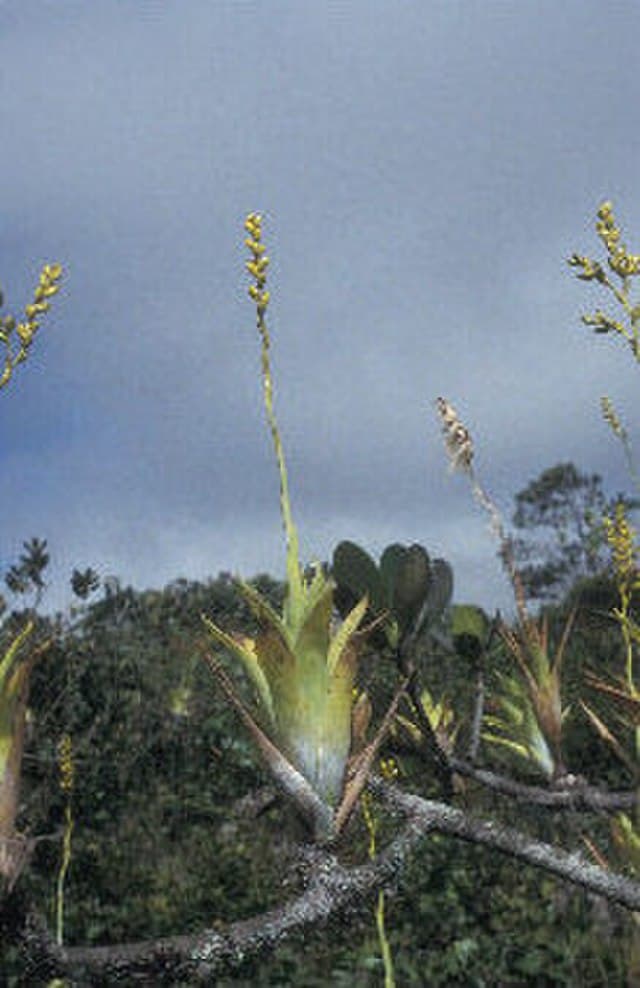
Catopsis berteroniana
A bromeliad carnivorous plant that traps insects with waxy leaf surfaces, drowning them in leaf-cup water for nutrients.
Catopsis berteroniana is a bromeliad (family Bromeliaceae) native to southern Florida, Central America, the Caribbean, and tropical South America, where it grows as an epiphyte in humid forests. It is considered the most carnivorous member of the Bromeliaceae, though it is debated as a true carnivore: the inner leaf surfaces are coated with ultraviolet-reflective white farina (waxy powder) that attracts and possibly disorients insects, causing them to fall into the central water-holding tank formed by the overlapping leaf bases. Trapped insects drown and are decomposed by microbial activity in the tank water, with the plant absorbing the released nutrients through specialized leaf trichomes. No digestive enzymes are produced by the plant itself. Cultivation follows bromeliad culture: epiphytic well-draining media, pure or rainwater in the central tank, high humidity, and warm temperatures (20–35°C).
Origine
Southern Florida, Central America, Caribbean, and tropical South America, humid forest epiphytes
Durée de vie
5-10 years
Taille
20-50cm
Température
10〜30℃
Humidité
60〜90%
Insects (auto-capture)
Waxy slip-trap
Tree-dwelling
Keep water in leaf cup
Bright indirect light
Intermediate. C'est une espèce de niveau intermédiaire. Une certaine expérience préalable et des connaissances en gestion environnementale sont recommandées.
La température idéale pour Catopsis Berteroniana est 10〜30℃. L'humidité recommandée est 60〜90%. Évitez les changements brusques de température et maintenez un environnement stable.
La durée de vie moyenne de Catopsis Berteroniana est 5-10 years. Avec des soins et une alimentation appropriés, ils peuvent vivre longtemps en bonne santé.
Catopsis Berteroniana atteint généralement 20-50cm à l'âge adulte. La taille peut varier selon les conditions de soins et la génétique individuelle.
Catopsis Berteroniana se nourrit de : Insects (auto-capture). Visez un régime équilibré avec une fréquence d'alimentation appropriée.
Le prix de Catopsis Berteroniana varie considérablement selon le morph, la taille et la lignée. Consultez notre page de prix du marché pour les dernières informations.
Trouver des annonces pour cette espèce
Parcourir les annonces Carnivorous PlantComplete Beginner's Guide to Carnivorous Plants
Everything beginners need to start growing carnivorous plants: soil, watering, light, tray culture, overwintering, and recommended starter species.
Carnivorous Plant Encyclopedia — Popular Species & Care Guide
An encyclopedia of popular carnivorous plants with trapping methods, care difficulty, and environment needs for each.
How Much Does Carnivorous Plant Growing Cost? Monthly Running Costs Explained
Monthly carnivorous plant care costs: soil, distilled water, and lighting, with Nepenthes vs. Venus flytrap cost comparisons.
Carnivorous Plant Growth Rate & Size — Species-by-Species Guide
Carnivorous plant growth rates and sizes for Venus flytraps, Nepenthes, and Sarracenia, with tips for growing larger traps.