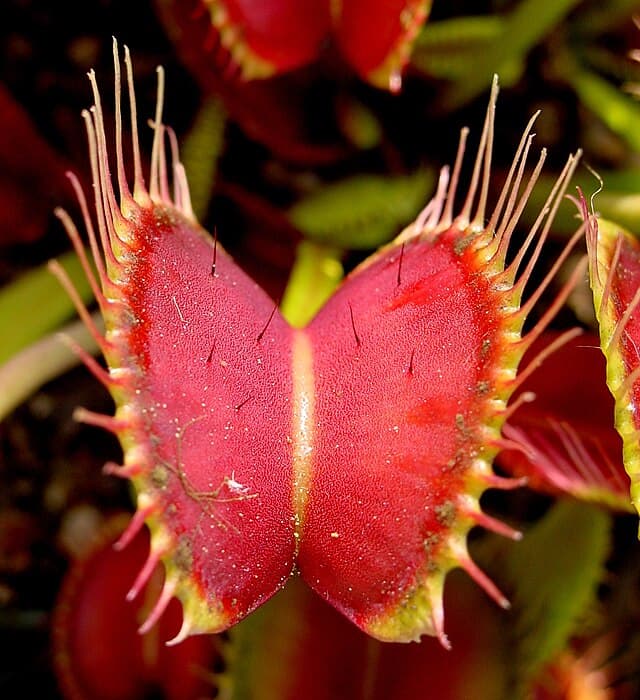
Source: Wikimedia Commons
Venus Flytrap
IntermediateDionaea muscipula
The world's most famous carnivorous plant. Clam-like leaves snap shut in 0.1 seconds to capture insects. Native only to Eastern US wetlands. Requires winter dormancy.
Dificultad
Intermediate
Temperatura
5〜35℃(冬は5℃前後で休眠)
Esperanza de vida
10-20 years
Tamaño
5-15cm
Humedad
60〜80%
Dieta
Photosynthesis + insect prey. Manual feeding unnecessary
Acerca de
The Venus flytrap (Dionaea muscipula) is a carnivorous plant native to the subtropical wetlands of North and South Carolina, USA, and is the sole species of the monotypic genus Dionaea. It belongs to the family Droseraceae, closely related to sundews and the waterwheel plant. The plant captures prey—chiefly insects and arachnids—using a hinged, jaw-like trap formed from the terminal portion of each leaf. When an insect contacts one of the trigger hairs inside the trap twice within approximately 20 seconds, the trap snaps shut in as little as one-tenth of a second. Digestive enzymes then dissolve the prey's soft tissue and the plant absorbs the resulting nutrients. Cultivation requires nutrient-poor, acidic media such as pure sphagnum moss or a peat-perlite mix, and fertilizer must never be used. Watering should be done by the tray method using only pure, distilled, or rainwater. Full sun is preferred, and a winter dormancy period at 5–10°C is essential for long-term health.
Source: Wikipedia (CC BY-SA 4.0)
Información básica
Origen
the temperate and subtropical wetlands of North Carolina and South Carolina, USA
Esperanza de vida
10-20 years
Tamaño
5-15cm
Temperatura
5〜35℃(冬は5℃前後で休眠)
Humedad
60〜80%
Dieta
Photosynthesis + insect prey. Manual feeding unnecessary
Guía de cuidado
Soil
Pure sphagnum or peat + perlite. Never use fertilizer
Watering
Bottom watering to keep constantly moist. Use distilled or rain water only
Dormancy
Needs 3-4 month cold dormancy in winter at around 5°C
Notes
Each trap closes only a few times in its life. Don't trigger traps for fun
IntermediateSnap trapDormancy requiredNorth American
Preguntas frecuentes de Venus Flytrap
Q¿Qué tan difícil es mantener Venus Flytrap?
A
Intermediate. Esta es una especie de nivel intermedio. Se recomienda algo de experiencia previa y conocimiento de gestión ambiental.
Q¿Cuál es la temperatura ideal para Venus Flytrap?
A
La temperatura ideal para Venus Flytrap es 5〜35℃(冬は5℃前後で休眠). La humedad recomendada es 60〜80%. Evita cambios bruscos de temperatura y mantén un ambiente estable.
Q¿Cuál es la esperanza de vida de Venus Flytrap?
A
La esperanza de vida promedio de Venus Flytrap es 10-20 years. Con cuidados y nutrición adecuados, pueden vivir una vida larga y saludable.
Q¿Qué tamaño alcanza Venus Flytrap?
A
Venus Flytrap típicamente alcanza 5-15cm como adulto. El tamaño puede variar según las condiciones de cuidado y la genética individual.
Q¿Qué debo alimentar a Venus Flytrap?
A
Venus Flytrap se alimenta de: Photosynthesis + insect prey. Manual feeding unnecessary. Apunta a una dieta equilibrada con una frecuencia de alimentación adecuada.
Q¿Cuál es el precio típico de Venus Flytrap?
A
El precio de Venus Flytrap varía significativamente según el morfo, tamaño y linaje. Consulta nuestra página de precios de mercado para información actualizada.
Especies relacionadas
Buscar listados de esta especie
Explorar listados de Carnivorous PlantArtículos relacionados
Venus Flytrap Variety Guide: Red, Giant & Unusual Cultivars
Venus flytrap variety guide: Red Dragon, B52 giant, Fang mutant, and more — characteristics and care differences for each cultivar.
Nepenthes vs. Venus Flytrap — Which Carnivorous Plant Is Easier to Grow?
Nepenthes vs. Venus flytrap comparison: growing conditions, temperature, watering, dormancy, and beginner-friendly varieties.
Venus Flytrap vs Nepenthes: Care, Cost & Feature Comparison
Venus Flytrap vs Nepenthes: trapping method, growing conditions, winter care, and price comparison.
Complete Venus Flytrap Care Guide
Caring for Venus flytraps: required light, water purity, soil type, and winter dormancy management, plus troubleshooting when traps won't close.