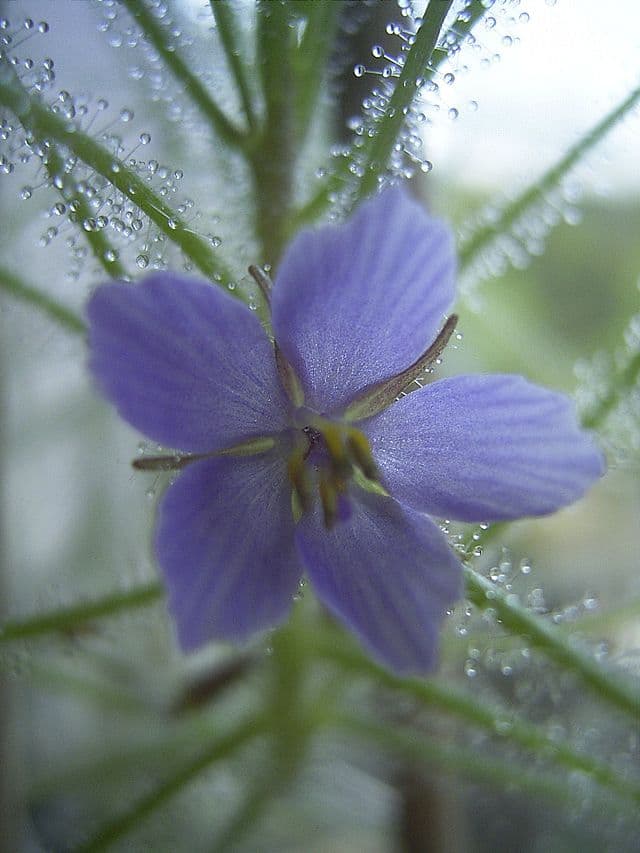
Source: Wikimedia Commons
Byblis Liniflora
IntermediateByblis liniflora
An Australian carnivorous plant with rainbow-glistening mucilage, called Rainbow Plant.
Dificultad
Intermediate
Temperatura
10〜30℃
Esperanza de vida
1-2 years (annual)
Tamaño
10-30cm
Humedad
60〜90%
Dieta
Insects (auto-capture)
Acerca de
Byblis liniflora, the rainbow plant, is an annual carnivorous plant native to the tropical wetlands and grasslands of northern Australia (Northern Territory and northern Queensland) and Timor. Its common name refers to the spectacular iridescent shimmer produced by the dense, gland-tipped mucilaginous tentacles covering its thread-like leaves—a prismatic rainbow effect in sunlight. Like all Byblis, it captures insects passively by adhesion to this sticky surface but lacks the ability to move its tentacles or leaves. It is treated as an annual in cultivation, germinating in autumn to spring and completing its cycle the same season. Cultivation uses sphagnum or peat-perlite media, tray watering with pure or rainwater, and full sun with warm temperatures (20–35°C). Seed germination may benefit from smoke treatment (smoke water soaking) as in other Australian fire-adapted flora.
Información básica
Origen
Northern Australia (Northern Territory and northern Queensland) and Timor, tropical grasslands and seasonal wetlands
Esperanza de vida
1-2 years (annual)
Tamaño
10-30cm
Temperatura
10〜30℃
Humedad
60〜90%
Dieta
Insects (auto-capture)
Guía de cuidado
Mucilage
Rainbow glistening
Lifespan
Annual
Seeds
Maintain from seed
Light
Full sun
CarnivorousByblisRainbowAnnual
Preguntas frecuentes de Byblis Liniflora
Q¿Qué tan difícil es mantener Byblis Liniflora?
A
Intermediate. Esta es una especie de nivel intermedio. Se recomienda algo de experiencia previa y conocimiento de gestión ambiental.
Q¿Cuál es la temperatura ideal para Byblis Liniflora?
A
La temperatura ideal para Byblis Liniflora es 10〜30℃. La humedad recomendada es 60〜90%. Evita cambios bruscos de temperatura y mantén un ambiente estable.
Q¿Cuál es la esperanza de vida de Byblis Liniflora?
A
La esperanza de vida promedio de Byblis Liniflora es 1-2 years (annual). Con cuidados y nutrición adecuados, pueden vivir una vida larga y saludable.
Q¿Qué tamaño alcanza Byblis Liniflora?
A
Byblis Liniflora típicamente alcanza 10-30cm como adulto. El tamaño puede variar según las condiciones de cuidado y la genética individual.
Q¿Qué debo alimentar a Byblis Liniflora?
A
Byblis Liniflora se alimenta de: Insects (auto-capture). Apunta a una dieta equilibrada con una frecuencia de alimentación adecuada.
Q¿Cuál es el precio típico de Byblis Liniflora?
A
El precio de Byblis Liniflora varía significativamente según el morfo, tamaño y linaje. Consulta nuestra página de precios de mercado para información actualizada.
Especies relacionadas
Buscar listados de esta especie
Explorar listados de Carnivorous PlantArtículos relacionados
Complete Beginner's Guide to Carnivorous Plants
Everything beginners need to start growing carnivorous plants: soil, watering, light, tray culture, overwintering, and recommended starter species.
Carnivorous Plant Encyclopedia — Popular Species & Care Guide
An encyclopedia of popular carnivorous plants with trapping methods, care difficulty, and environment needs for each.
How Much Does Carnivorous Plant Growing Cost? Monthly Running Costs Explained
Monthly carnivorous plant care costs: soil, distilled water, and lighting, with Nepenthes vs. Venus flytrap cost comparisons.
Carnivorous Plant Growth Rate & Size — Species-by-Species Guide
Carnivorous plant growth rates and sizes for Venus flytraps, Nepenthes, and Sarracenia, with tips for growing larger traps.