Source: Wikimedia Commons
Source: Wikimedia Commons
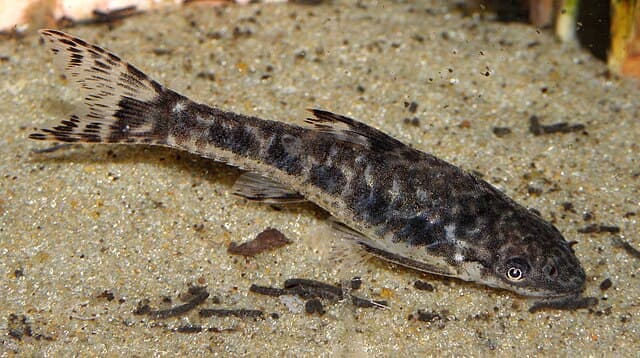
Small catfish that eats algae on glass and plants. Peaceful and essential for planted tanks. More secure in groups.
Otocinclus, commonly called 'otos' or dwarf suckers, are small loricariid catfish distributed across river systems from Venezuela to northern Argentina in South America. Reaching only 2–5 cm, they use their sucker-like mouths to graze on soft green algae, diatoms, and biofilm from glass surfaces, plant leaves, and driftwood — making them exceptional algae controllers in planted aquariums. Unlike some larger algae eaters, they do not damage delicate plants and can clean even the smallest leaf surfaces. Being shy and somewhat fragile, they should be kept in groups of three or more for confidence. They adapt well to water temperatures of 22–28°C and slightly acidic to neutral water (pH 6.5–7.5). When aquarium algae is insufficient, their diet must be supplemented with blanched zucchini or sinking algae wafers. Breeding in captivity is challenging — most available specimens are wild-caught — requiring excellent water quality and an abundance of plant-based nutrition. Newly imported specimens often have compromised digestive systems, requiring special care during acclimation.
Source: Wikipedia (CC BY-SA 4.0)
Herkunft
South America, commonly known as "dwarf suckers" or "otos"
Lebensdauer
3-5 years
Größe
3-5cm
Temperatur
22〜28℃
Algae, tablet food
Ideal for planted tanks. 30cm+
Keep 3+ together
Supplement with pleco tablets when algae is scarce
Prefers clean water. Regular water changes
Risk of starvation after introduction — ensure algae supply
Beginner. Dies ist eine anfängerfreundliche Art. Es sind keine spezielle Ausrüstung oder Erfahrung erforderlich, und sie kann mit einer einfachen Pflegeeinrichtung erfolgreich gehalten werden.
Die ideale Temperatur für Otocinclus ist 22〜28℃. Vermeiden Sie plötzliche Temperaturänderungen und halten Sie eine stabile Umgebung aufrecht.
Die durchschnittliche Lebensdauer von Otocinclus beträgt 3-5 years. Bei richtiger Pflege und Ernährung können sie ein langes und gesundes Leben führen.
Otocinclus erreicht als Erwachsener typischerweise 3-5cm. Die Größe kann je nach Haltungsbedingungen und individueller Genetik variieren.
Otocinclus ernährt sich von: Algae, tablet food. Streben Sie eine ausgewogene Ernährung mit angemessener Fütterungshäufigkeit an.
Der Preis von Otocinclus variiert erheblich je nach Morph, Größe und Abstammung. Überprüfen Sie unsere Marktpreisseite für aktuelle Preisinformationen.
Angebote für diese Art finden
Tropical Fish-Angebote durchsuchenCorydoras vs Otocinclus: Difficulty, Cost & Feature Comparison
Corydoras vs otocinclus: roles, difficulty, and compatibility as tank cleaners.
Complete Beginner's Guide to Tropical Fish Keeping
Everything beginners need to start keeping tropical fish: essential equipment, water preparation, and recommended starter species.
Tropical Fish Water Quality Management & Water Change Basics
Essential water quality management for tropical fish: understanding pH, ammonia, nitrite, nitrate, and how to perform water changes correctly.
Tropical Fish Community Tank Guide — Compatible Combinations & Precautions
How to successfully keep tropical fish together: compatibility rules, recommended combinations, and what species should never be mixed.