Source: Wikimedia Commons
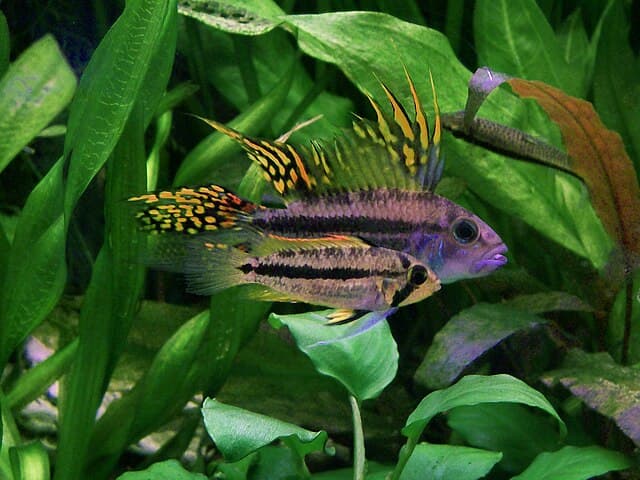
Apistogramma Cacatuoides
IntermediateApistogramma cacatuoides
A dwarf cichlid spreading vivid orange fins. Male fin spreading display is spectacular.
Schwierigkeit
Intermediate
Temperatur
22〜28℃
Lebensdauer
3-5 years
Größe
5-8cm
Ernährung
Frozen food, Pellets
Über uns
Apistogramma cacatuoides, the cockatoo dwarf cichlid, is native to the upper Amazon River basin in Peru, Colombia, and Brazil. Males reach 5–8 cm and are renowned for the dramatically elongated anterior rays of the dorsal fin — flaring like the crest of a cockatoo parrot, the namesake feature. During courtship and territorial displays, males spread their vivid red, orange, and yellow fins in a spectacular fan — one of the most dramatic visual displays in dwarf cichlid keeping. Numerous selectively bred varieties are available, including double red, orange flash, and gold forms. Water conditions should be slightly acidic to neutral (pH 5.5–7.0) at 24–28°C in soft water. Cave-spawning behavior is typical: females deposit eggs in coconut shells or driftwood hollows and defend the territory ferociously — even chasing away the male. The species naturally practices polygyny; harem-style keeping with one male and multiple females in separate territories is a rewarding advanced approach. Among the most accessible Apistogramma species, cacatuoides is often recommended as an entry point into dwarf cichlid breeding.
Grundinformationen
Herkunft
upper Amazon River basin (Peru, Colombia, Brazil)
Lebensdauer
3-5 years
Größe
5-8cm
Temperatur
22〜28℃
Ernährung
Frozen food, Pellets
Pflegeanleitung
Water
Slightly acidic to neutral (pH 5.5-7.0)
Temperature
Maintain 24-28°C
Breeding
Females protect eggs with maternal behavior
Notes
Cave-like hides become spawning sites
ApistoDwarf cichlidOrange finsSpawning
Apistogramma Cacatuoides-FAQ
QWie schwierig ist es, Apistogramma Cacatuoides zu halten?
A
Intermediate. Dies ist eine Art mittleren Schwierigkeitsgrades. Etwas Vorerfahrung und Kenntnisse im Umgebungsmanagement werden empfohlen.
QWas ist die ideale Temperatur für Apistogramma Cacatuoides?
A
Die ideale Temperatur für Apistogramma Cacatuoides ist 22〜28℃. Vermeiden Sie plötzliche Temperaturänderungen und halten Sie eine stabile Umgebung aufrecht.
QWie ist die Lebenserwartung von Apistogramma Cacatuoides?
A
Die durchschnittliche Lebensdauer von Apistogramma Cacatuoides beträgt 3-5 years. Bei richtiger Pflege und Ernährung können sie ein langes und gesundes Leben führen.
QWie groß wird Apistogramma Cacatuoides?
A
Apistogramma Cacatuoides erreicht als Erwachsener typischerweise 5-8cm. Die Größe kann je nach Haltungsbedingungen und individueller Genetik variieren.
QWas sollte ich Apistogramma Cacatuoides füttern?
A
Apistogramma Cacatuoides ernährt sich von: Frozen food, Pellets. Streben Sie eine ausgewogene Ernährung mit angemessener Fütterungshäufigkeit an.
QWas ist der typische Preis für Apistogramma Cacatuoides?
A
Der Preis von Apistogramma Cacatuoides variiert erheblich je nach Morph, Größe und Abstammung. Überprüfen Sie unsere Marktpreisseite für aktuelle Preisinformationen.
Apistogramma Cacatuoides Q&A
Verwandte Arten
Angebote für diese Art finden
Tropical Fish-Angebote durchsuchenVerwandte Artikel
Complete Beginner's Guide to Tropical Fish Keeping
Everything beginners need to start keeping tropical fish: essential equipment, water preparation, and recommended starter species.
Tropical Fish Water Quality Management & Water Change Basics
Essential water quality management for tropical fish: understanding pH, ammonia, nitrite, nitrate, and how to perform water changes correctly.
Tropical Fish Community Tank Guide — Compatible Combinations & Precautions
How to successfully keep tropical fish together: compatibility rules, recommended combinations, and what species should never be mixed.
Most Popular Tropical Fish Species in 2025
Top 10 tropical fish of 2025, from easy-to-keep beginner species to stunning advanced varieties, with care tips for each.