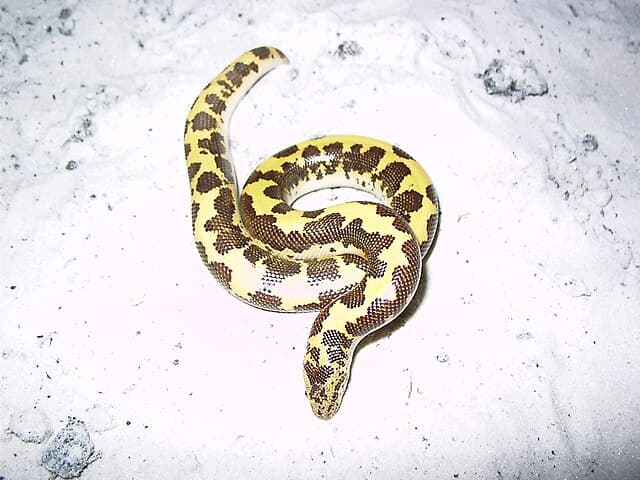
Source: Wikimedia Commons
Kenyan Sand Boa
BeginnerA small boa living buried in sand. Gentle and space-efficient beginner snake.
Schwierigkeit
Beginner
Temperatur
25〜32℃
Lebensdauer
15-20 years
Größe
40-70cm
Luftfeuchtigkeit
40〜70%
Ernährung
Mice
Über uns
The Kenyan sand boa (Gongylophis colubrinus), also called the Egyptian sand boa, is a small, burrowing boa native to arid and semi-arid regions of East Africa, including Kenya, Tanzania, Egypt, Ethiopia, and Sudan. Adults typically reach 40–70 cm, with females considerably larger than males. The body is stout and cylindrical, and the blunt tail is used to anchor the snake while it bursts from the substrate to seize prey. Coloration is typically orange or yellow with brown saddle blotches. Kenyan sand boas are highly docile, rarely bite, and can be housed in compact enclosures with a deep sand substrate that allows burrowing. A hot spot of around 35°C and a cool side of 25°C are recommended. Their small size, gentle temperament, and ease of care make them one of the most recommended beginner snakes.
Grundinformationen
Herkunft
East Africa (Kenya, Egypt, Ethiopia, Sudan and surrounding regions)
Lebensdauer
15-20 years
Größe
40-70cm
Temperatur
25〜32℃
Luftfeuchtigkeit
40〜70%
Ernährung
Mice
Pflegeanleitung
Housing
Small cage with sand substrate
Temperature
Hot spot 35°C, cool side 25°C
Feeding
Small mouse every 2 weeks
Notes
Usually hidden buried in sand
Sand BoaSand burrowingSmallSpace-efficient
Kenyan Sand Boa-FAQ
QWie schwierig ist es, Kenyan Sand Boa zu halten?
A
Beginner. Dies ist eine anfängerfreundliche Art. Es sind keine spezielle Ausrüstung oder Erfahrung erforderlich, und sie kann mit einer einfachen Pflegeeinrichtung erfolgreich gehalten werden.
QWas ist die ideale Temperatur für Kenyan Sand Boa?
A
Die ideale Temperatur für Kenyan Sand Boa ist 25〜32℃. Die empfohlene Luftfeuchtigkeit beträgt 40〜70%. Vermeiden Sie plötzliche Temperaturänderungen und halten Sie eine stabile Umgebung aufrecht.
QWie ist die Lebenserwartung von Kenyan Sand Boa?
A
Die durchschnittliche Lebensdauer von Kenyan Sand Boa beträgt 15-20 years. Bei richtiger Pflege und Ernährung können sie ein langes und gesundes Leben führen.
QWie groß wird Kenyan Sand Boa?
A
Kenyan Sand Boa erreicht als Erwachsener typischerweise 40-70cm. Die Größe kann je nach Haltungsbedingungen und individueller Genetik variieren.
QWas sollte ich Kenyan Sand Boa füttern?
A
Kenyan Sand Boa ernährt sich von: Mice. Streben Sie eine ausgewogene Ernährung mit angemessener Fütterungshäufigkeit an.
QWas ist der typische Preis für Kenyan Sand Boa?
A
Der Preis von Kenyan Sand Boa variiert erheblich je nach Morph, Größe und Abstammung. Überprüfen Sie unsere Marktpreisseite für aktuelle Preisinformationen.
Verwandte Arten
Angebote für diese Art finden
Reptile & Amphibian-Angebote durchsuchenVerwandte Artikel
Chinchilla Dust Bath Complete Guide — Sand Selection, Frequency & Setup
Everything about chinchilla dust baths: choosing the right dust, bath frequency, container selection, and maintaining coat quality.
7 Common Beginner Mistakes in Reptile Keeping
Seven common mistakes beginners make with reptiles, including temperature errors, UVB neglect, overfeeding, and delayed shed care.
Reptile Encyclopedia — Popular Species & Care Guide
An encyclopedia of popular reptile species with care difficulty, equipment needs, and temperament for each.
Top 5 Reptile Species for First-Time Owners
Recommended reptile species for beginners, evaluated by ease of care, cost, and temperament.